


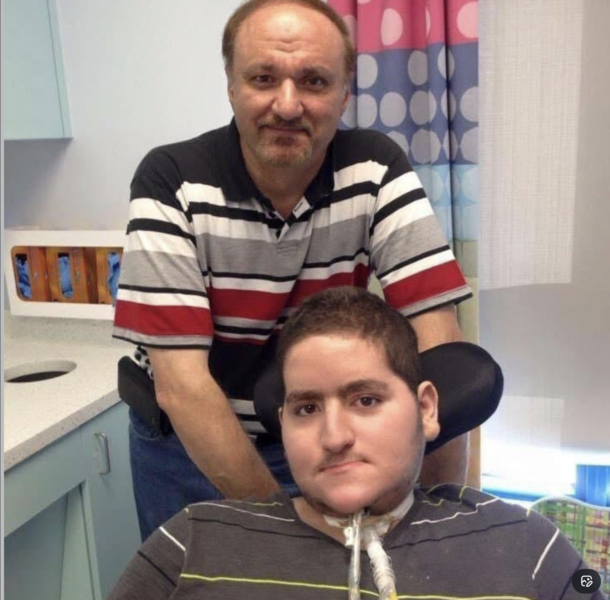
From a hospital bed in Arlington, Texas, Wael Tarabishi asked for only one thing: the return of his father.
His father, Maher Tarabishi, had been detained by U.S. Immigration and Customs Enforcement in late October during a routine check-in. He was Wael’s full-time carer and the person on whom his daily survival depended. Wael described the fear of losing him as “real and immediate”.
Wael died on 23 January 2026 after more than a month in hospital.
His story stays with me not because it is uniquely shocking, but because it exposes something deeply troubling about how modern immigration enforcement systems operate — and who they harm when compassion is stripped from decision-making.
A system that doesn’t see dependency
Wael lived with Pompe disease, a rare and progressive condition affecting muscle strength and respiratory function. His father, Maher Tarabishi, was his full-time carer. That relationship was not incidental to Wael’s survival; it was foundational to it.
When U.S. Immigration and Customs Enforcement detained Maher in Arlington, it did not merely separate a family. It removed a critical element of care from a person who depended on it for daily life, safety, and emotional stability.
Maher Tarabishi was not a violent offender and had no criminal record; he had lived in the US for over 30 years and followed every rule. Yet, the system processed him as a number, not a caregiver. ICE has not publicly produced evidence of criminal wrongdoing. Claims circulating online about historic political links have been denied by the family and have not been substantiated through any judicial process.
This is the central failure. Immigration enforcement systems are designed to process individuals, not relationships. They struggle to recognise dependency, care, and vulnerability — especially where severe disability is involved.
What lived experience tells us
I have fact-checked Wael Tarabishi’s case carefully. His death from Pompe disease cannot be legally attributed, in a narrow sense, to his father’s detention.
But anyone who understands severe disability — and I do more than most — knows what happens when a primary carer is suddenly removed. Fear, stress, and disruption enter a body already under immense strain. Wael lived with a severe neuromuscular condition and relied on a respirator to breathe, circumstances that mirror my own experience closely enough to make the consequences painfully clear.
Those pressures are not abstract. They have physiological consequences. They shorten lives.
This is why disabled people and their families are uniquely vulnerable when systems prioritise enforcement over judgement.
Wael’s words and final plea
Before he died, Wael recorded a message from his hospital bed describing the impact of losing his father’s support. It is difficult to watch without feeling that something fundamental has broken.
His words are not political. They are human. They speak of fear, abandonment, and the quiet devastation of being left without the one person who made daily life possible.
This was not a failure of individual empathy. It was the predictable outcome of a system designed to keep moving regardless of who it harms.
Why this matters beyond the US
It would be a mistake to treat Wael’s death as a distant American tragedy. In the UK, the language of “toughness” is increasingly being used to mask a similar disregard for human dependency.
Language matters. When immigration enforcement is framed in terms of “toughness” or “control”, compassion is often recast as weakness rather than judgement.
In the UK, senior politicians have begun to reference US-style approaches. Kemi Badenoch has spoken of an “ICE-style” removals force. Reform UK openly advocates a “Deportation Command” supported by a “Data Fusion Centre” to track people through the NHS.
These are not neutral administrative terms. They signal a shift toward a model of enforcement that risks repeating the same blind spots—treating carers as disposable and disabled people as collateral damage.
Compassion is not optional
Concern about immigration is legitimate. Most people share it. But compassion is not an optional extra that can be bolted on once enforcement goals are met.
It must be built into the system itself.
That means recognising dependency. It means treating carers as essential, not disposable. It means understanding that for some people, separation is not inconvenience — it is existential.
When those realities are ignored, Wael’s case stops being exceptional. It becomes foreseeable.
Conclusion
Next time senior politicians in the UK appear on television or social media talking tough on immigration, we cannot say we have not been warned by events in the United States.
A tragic case like Wael Tarabishi’s is not a remote possibility. It is a foreseeable consequence of immigration enforcement that loses sight of disability, care, and basic human compassion.
If systems are judged only by how efficiently they remove people, they will inevitably fail those who cannot survive without being seen.