

Meta’s decision to cap free use of Conversation Focus on its smart glasses should worry anyone who cares about the future of mainstream accessible technology.
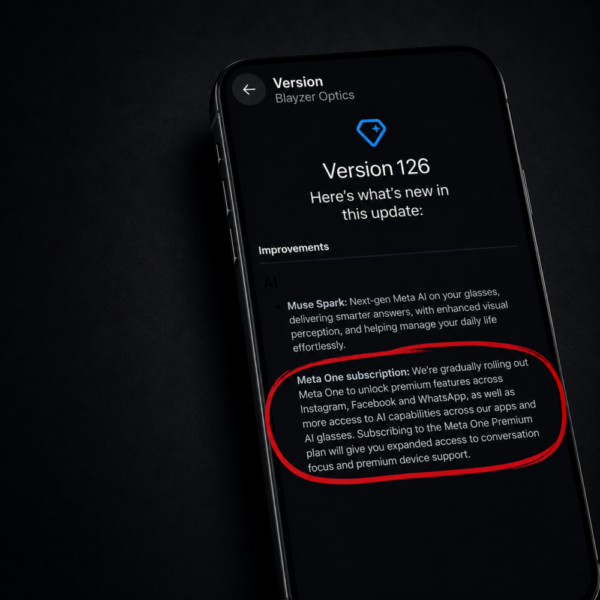
I first spotted the issue in the Version 126 release notes for my Ray-Ban Meta smart glasses, which appeared for me in the UK last Friday. It looked like a big update. Muse Spark was the headline feature, promising next-generation Meta AI on the glasses. The same release also listed Dynamic Photo, live location sharing, WhatsApp voice chats, Battery Saver Mode, smoother iPhone media imports, improved hibernation, wider language support and in-call voice commands.
There was a lot to welcome, even if many of the features have not yet reached the UK because of Meta’s somewhat frustrating geographically staggered rollout.
But one line in the release notes immediately stood out. Meta One Premium was described as offering “expanded access to conversation focus” and premium device support.
That wording raised the obvious question in my mind: was an accessibility-enhancing feature on smart glasses about to become part of a paid subscription?
The Verge has since reported the detail behind that concern. According to Meta’s own help page, Conversation Focus will be available free for only three hours a month, while Meta One Premium subscribers will receive up to 15 hours a month.
Meta’s position is that a subscription is not required to keep using AI glasses, and that most people will use Conversation Focus without hitting the monthly limit. It says the paid plan is aimed at power users who want expanded access and premium device support.
That may be true for average use. It may also be true that some people will never come close to three hours a month.
But that does not answer the accessibility question.
If a feature helps people communicate in noisy environments, the issue is not only how many users hit the limit. The issue is whether an accessibility-enhancing feature should be metered at all.
The concern becomes sharper because Conversation Focus appears to run on the glasses themselves. It does not appear to rely on Meta’s servers.
That makes the decision much harder to justify.
This is not a heavy cloud AI feature where a company can point to ongoing server costs. It is a local feature, using the hardware already sitting on the user’s face. People have bought the glasses. The capability is in the product. Yet use of that capability is now being rationed.
That is a poor precedent for consumer technology.
It is a worse precedent for accessibility.
What Conversation Focus does
Conversation Focus is designed to make it easier to hear the person you are speaking to in noisy places. Meta describes it as a feature that amplifies voices directly in front of you, such as in restaurants, busy offices or crowded parties.
For some people, that may sound like a useful convenience.
For others, it can be the difference between joining a conversation and being pushed out of it.
Meta says Conversation Focus is not a hearing aid or medical device. That distinction may be legally and medically important. But it does not settle the accessibility question.
Accessibility is not limited to regulated medical devices. A wheelchair is assistive technology. So is speech recognition. So are captions. So is a camera on smart glasses if it allows a blind person to get visual assistance, or a severely physically disabled person to share what they are seeing without holding a phone.
A feature can be consumer technology and still be access technology.
That is precisely why this issue is important.
Accessibility must not become a premium tier
Meta should come out clearly and say that accessibility is a fundamental core value, and that it will not put accessibility-enhancing features behind a paid subscription.
That does not mean every advanced AI service has to be free forever. If a feature depends on expensive cloud processing, heavy generation, or ongoing server-side computation, there is a separate commercial debate to be had.
But there needs to be a bright line.
If a feature supports communication, hearing, vision, physical access, safety, navigation or basic control of a device, it should not be treated as a luxury add-on.
Conversation Focus sits very close to that line. I would argue it crosses it.
It helps people follow face-to-face conversation. It may reduce the effort of listening in noisy spaces. It may help someone remain socially connected in environments that would otherwise exclude them.
That is not just a premium experience.
It is access.
The World Health Organisation estimates that more than 2.5 billion people need one or more assistive products today. That number is expected to rise as populations age and more people live with long-term conditions.
Mainstream technology companies are increasingly part of that assistive technology landscape. Voice control, captions, live translation, AI description, hearing enhancement, wearable cameras and hands-free communication are no longer niche extras. They are becoming part of everyday access.
That is why pricing decisions like this are not minor.
They shape trust.
If disabled people begin to rely on smart glasses to communicate, hear, see, share, navigate or control their digital lives, they need confidence that essential access features will not later become metered upgrades.
Meta deserves credit too
This criticism needs to be balanced with something equally important.
Meta is doing some of the most interesting work in mainstream accessible technology right now. Its smart glasses are already useful to blind people, visually impaired people and physically disabled people who cannot pick up a phone.
I say that from direct experience.
I am more or less paralysed from the neck down by a muscle-wasting condition. During the whole smartphone era, I could not pick up a phone, take photos, or share what I was seeing with family and friends.
Meta glasses changed that.
The phone was the barrier. The glasses removed it.
For people like me, smart glasses are not creepy by default. They can make the ordinary human act of sharing accessible.
Seeing something, capturing it and sharing it with someone else is a basic part of modern life. For many years, the smartphone made that easier for most people, but not for me. I could dictate into a computer, make calls, and use voice control in some situations. But I could not casually point a phone at something, take a picture and send it to someone.
With Meta glasses, I can.
That is not novelty. It is a form of access.
Version 126 also brings genuinely useful accessibility gains
That is why I do not want the Conversation Focus paywall to obscure the good work Meta is doing.
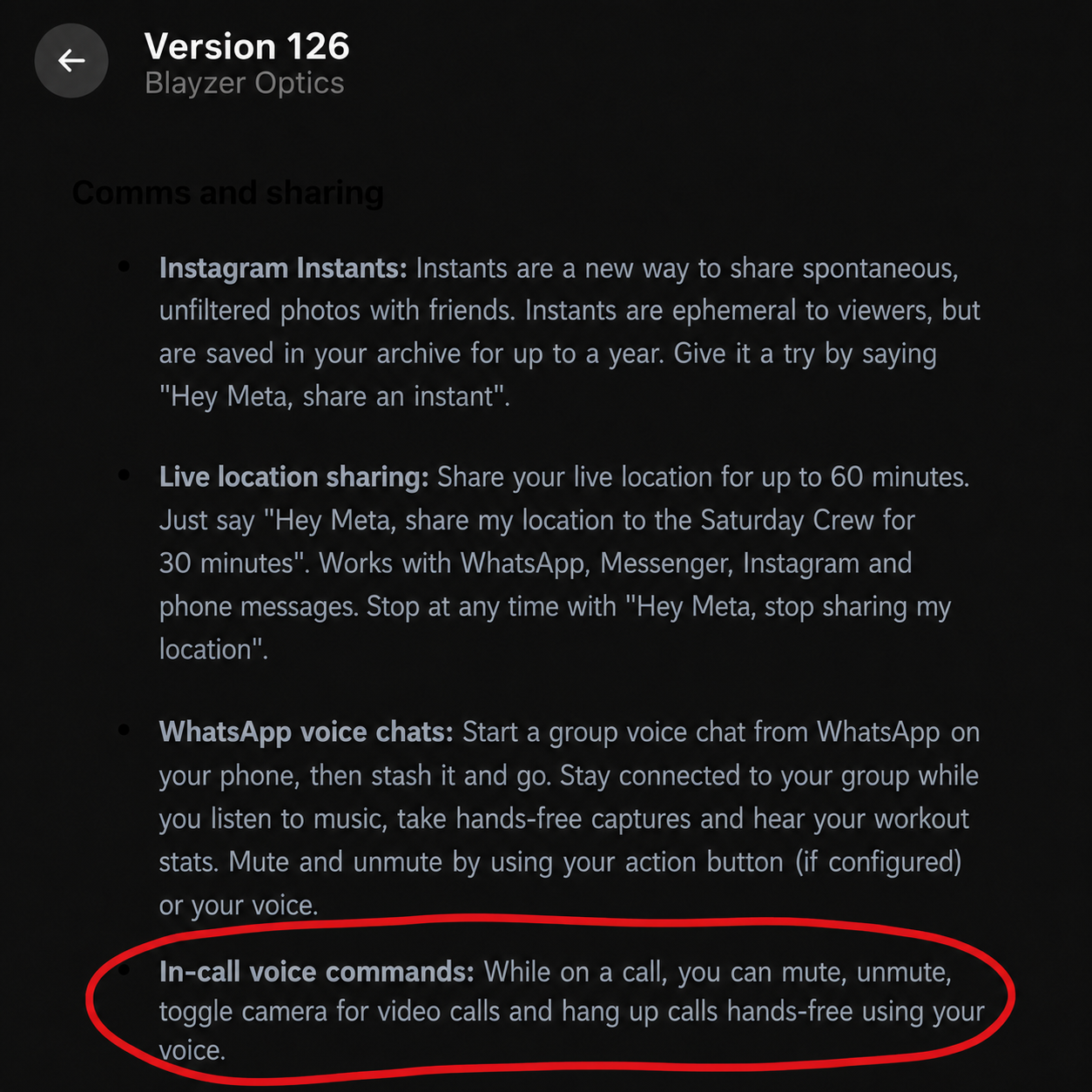
The same Version 126 update includes in-call voice commands. While on a call, users can mute, unmute, toggle the camera during video calls and hang up calls hands-free using their voice.
This is exactly the kind of practical feature I have long called for.
In my earlier Ray-Ban Meta smart glasses Gen 2 review, I set out why hands-free features such as call control, point-of-view sharing and better voice commands are not small conveniences for disabled people. They are central to whether the glasses work as a serious access tool.
If you can tap a phone screen, ending a call is nothing. If you cannot move your hands, it can be a real problem. Even something as mundane as dismissing an unwanted call becomes unnecessarily difficult.
A simple “Hey Meta, hang up” command may sound small. For someone who relies on voice control, it is not small at all.
The same applies to sharing your point of view during WhatsApp video calls. Being able to say “Hey Meta, turn on camera” and show someone what I am seeing is a meaningful form of independence.
It lets me include people in my world without needing someone else to hold a phone for me.
You cannot put a price on that kind of independence.
The privacy debate is real, but incomplete
Meta smart glasses are also facing understandable criticism.
There are serious concerns about misuse, covert filming, privacy, and the risks to women and children in particular. Those concerns should not be dismissed. Misuse of camera glasses can be invasive and harmful.
But the public debate too often swings between two extremes.
Smart glasses are either presented as a surveillance threat or as a shiny consumer gadget. The accessibility case is squeezed out.
For severely physically disabled people and blind people, the benefits are too important to be treated as a footnote.
The right response is not to pretend misuse does not happen. It is to deal with misuse properly while keeping the access benefits in view.
That means stronger safeguards, clearer recording indicators, better enforcement, and social norms that make misuse unacceptable.
But disabled people should not lose access because other people use the technology wrongly.
Deal with misuse, but keep accessibility in the conversation too.
The Apple comparison is now unavoidable
9to5Mac has argued that Meta’s move could be good news for future Apple glasses. That seems right.
Apple has spent years building a reputation around accessibility. It is not perfect. Disabled people who rely on Apple products know there are still bugs, delays and gaps. But Apple has generally understood the strategic and moral value of making accessibility part of the operating system, not an optional paid add-on.
If Apple enters the smart glasses market and says clearly that accessibility-enhancing features will not be put behind a subscription, Meta will have handed it an easy point of contrast.
That would be a shame, because Meta is ahead in this category today.
It has real products, real users and real access use cases. It has smart glasses that already make a difference in everyday life. It has also shown signs that it listens to disabled people.
That is why this decision feels so disappointing.
Not because Meta is doing nothing right.
Because Meta is doing enough right for this to feel like the wrong turn at the wrong moment.
Meta should rethink this
Meta should rethink the Conversation Focus cap.
It can keep Meta One Premium for genuinely premium services: advanced cloud AI, heavier processing, additional storage, enhanced support and features that clearly carry ongoing infrastructure costs.
But accessibility-enhancing features should remain part of the standard smart glasses experience.
Conversation Focus is the wrong feature to use as an early test case for subscription limits. It is local, practical and closely connected to human communication. It is exactly the kind of feature Meta should be proud to include, not meter after people have bought the hardware.
Meta’s smart glasses have already changed daily life for some disabled people. They have helped turn a consumer product into an access tool. That is why this decision needs to be challenged.
Accessibility should not become a premium tier.
Meta should say that clearly, then prove it.