

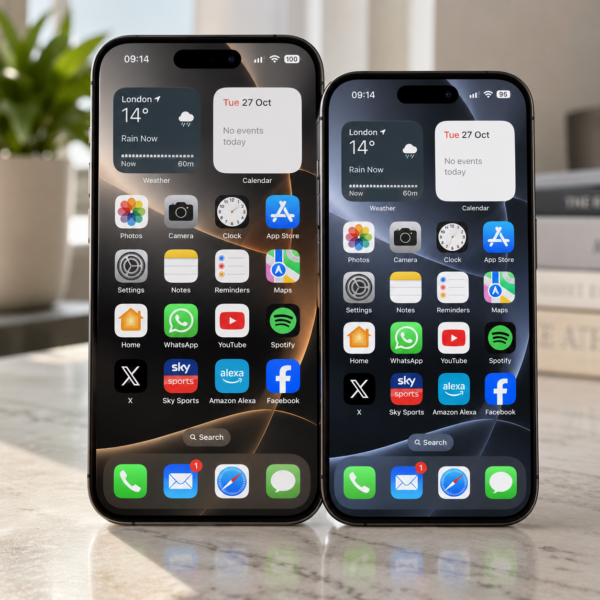
Apple’s new iPhone Handoff feature is now available to EE customers, making EE the first UK mobile network to offer the technology that allows two iPhones to share a single mobile number.
The service became available on Monday 26 October, coinciding with Apple’s release of iOS 27.2 at approximately 6pm UK time. EE had confirmed the planned launch date to me ahead of the release.
I successfully activated iPhone Handoff on my iPhone 18 Pro and iPhone 17 Pro on Tuesday morning and tested switching between the two devices. The process works seamlessly, with my mobile number transferring automatically when I unlock the other handset.
It’s an attractive proposition for people who want the flexibility of using different iPhones for different occasions. But Apple’s approach raises an important accessibility question: what happens when someone cannot physically unlock the phone they want to use?
What is iPhone Handoff and how does it work?
iPhone Handoff allows two compatible iPhones to share a single mobile number through eSIM technology. Only one handset is active on the mobile network at any given time.
According to Apple’s official instructions, unlocking either iPhone makes it the active device, transferring the mobile service from the other handset. Calls, voicemail, messages (including iMessage, RCS and SMS) and Find My location follow the active phone, while other information synchronised through iCloud remains available across both devices.
Someone might prefer a larger iPhone for work but carry a smaller, lighter model when exercising, travelling or going out for the evening. Others might keep one handset at home and another for use outside.
The feature also gives older iPhones a useful second life. Rather than leaving a previous handset unused after upgrading, owners can continue using it alongside their newer model without needing another telephone number.
Importantly, iPhone Handoff is not restricted to Apple’s foldable iPhone Duo, which features prominently in EE’s promotional material. It works with other compatible iPhones, subject to network support and software requirements.
EE becomes the first UK network to offer iPhone Handoff
EE joins T-Mobile in the United States and Telekom in Germany among the first mobile operators to support iPhone Handoff.
The British network offers the service for £5 per month on a rolling contract with eligible unlimited and uncapped plans. It is also included at no additional charge with EE’s Full Works Plus package.
Customers need two compatible iPhones, both signed into the same Apple Account, with the necessary iCloud and messaging settings enabled.
After installing iOS 27.2, I completed the setup process on Tuesday morning.
The procedure involved adding the secondary eSIM, confirming iPhone Handoff on my primary handset and allowing EE to complete the network activation. Apple’s confirmation process also required a double-click of the iPhone’s side button.
During activation, a message appeared confirming that my network provider was finishing the process. Shortly afterwards, the service was working.
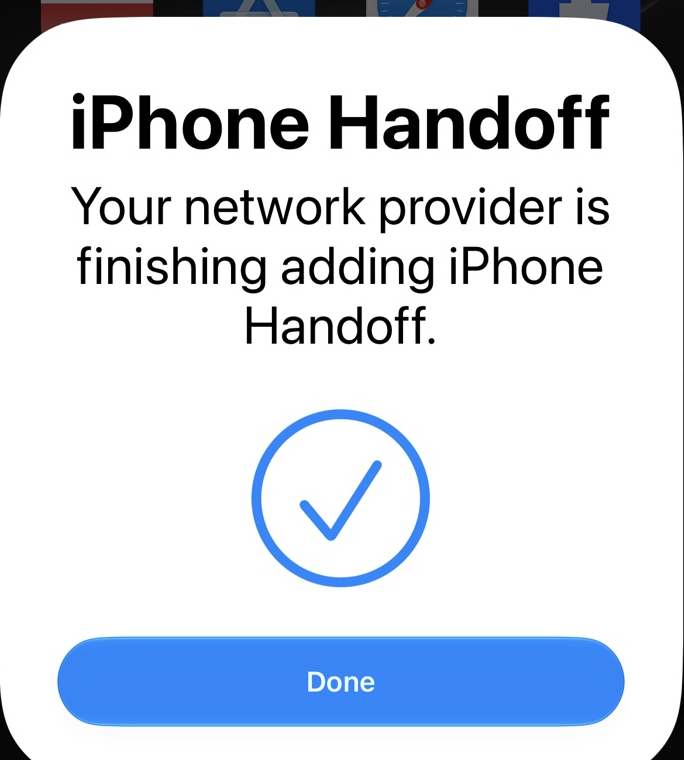
EE has now published a dedicated iPhone Handoff setup guide, including eligibility requirements, activation instructions and troubleshooting advice.
EE deserves credit for introducing the technology to the UK. However, while the service offers greater flexibility, Apple’s implementation presents a significant obstacle for some disabled people.
Why iPhone Handoff presents an accessibility problem
I have muscular dystrophy and use a powered wheelchair. I have extremely limited movement in my arms and hands and cannot physically pick up or operate an iPhone in most situations.
I rely heavily on Apple’s Voice Control, Siri and other hands-free technologies to use my devices independently.
My primary iPhone 18 Pro is used at home, while my secondary iPhone 17 Pro is carried in a pocket on the side of my powered wheelchair when I go out. It is not mounted in front of me, and I cannot retrieve it, see the screen or physically interact with it.
Ideally, I would like to leave home with my secondary iPhone and have my mobile number transfer automatically, without needing to think about which handset is active.
Although I have successfully activated and tested iPhone Handoff, the switching mechanism remains a problem. Unlocking the other handset transfers my mobile number seamlessly, but I cannot physically unlock my secondary iPhone when it is in my wheelchair pocket.
I could ask somebody else to retrieve and unlock it before leaving home. But I don’t want to depend on another person to prepare my phone every time I go out.
The attraction of iPhone Handoff is convenience and flexibility. For disabled people who cannot physically handle their phones, those benefits should not depend on someone else’s assistance.
Could Apple make switching completely hands-free?
There are several ways Apple could potentially address this problem without removing the existing unlock-based switching mechanism.
The most useful would be automatic switching based on location or proximity.
For example, if I leave home with my secondary iPhone while my primary handset remains behind, the system could recognise which device I am carrying and transfer the mobile number accordingly. When I return home, the process could reverse.
Such a feature would need appropriate safeguards against unwanted switching, particularly when both devices are nearby. It should therefore be optional, with users retaining control over how it operates.
Another possibility would be Siri integration. A command such as “Siri, switch my mobile number to my secondary iPhone” could allow someone to initiate the transfer without physically handling either handset.
Apple could also introduce a dedicated Shortcuts action, allowing users to create personal automations based on location or other conditions. A Shortcut could also be triggered by voice.
These are suggestions, not existing capabilities. Apple’s published documentation does not currently describe automatic location-based switching, a dedicated Siri command or Shortcuts integration for transferring the active mobile number.
There may be technical and security considerations involved, but the possibilities deserve examination.
Apple’s accessibility record makes this worth addressing
Apple has made substantial contributions to accessibility through features such as Voice Control, VoiceOver and Switch Control. These technologies have transformed how many disabled people use mainstream devices.
That is why the limitation in iPhone Handoff is disappointing.
The switching mechanism appears to assume that users can physically access and unlock whichever handset they want to activate. Yet some disabled people carry their phones in wheelchair pockets, bags or other locations where direct interaction is impossible.
Providing alternative ways to control iPhone Handoff would address that problem while potentially improving the experience for everyone.
After all, automatic switching and voice control could be useful to people without disabilities too. That is often the value of accessibility improvements: they make mainstream technology more flexible for a wider range of people.
A constructive challenge to Apple
I have contacted Apple’s Accessibility team to ask whether there is an existing way to transfer the active mobile number independently, without unlocking the secondary handset.
My questions cover automatic switching, Siri, Shortcuts and any other supported hands-free methods. I have also asked that my feedback be shared with the team responsible for developing iPhone Handoff.
I recognise that Apple may have technical reasons for its current approach, and I am not suggesting that unlock-based switching should be removed.
But there is a strong case for providing an alternative that does not require physical interaction with either device.
EE’s UK launch is a positive development. Having successfully activated and tested iPhone Handoff, I can confirm that switching between my two iPhones works seamlessly. Unlocking the other handset transfers my mobile number without any additional steps.
However, that requirement to unlock the handset remains the obstacle. When my secondary iPhone is in my wheelchair pocket, I cannot physically access it to initiate the switch.
My challenge to Apple is simple: make iPhone Handoff work just as seamlessly for people who cannot physically handle their phones as it does for those who can.