


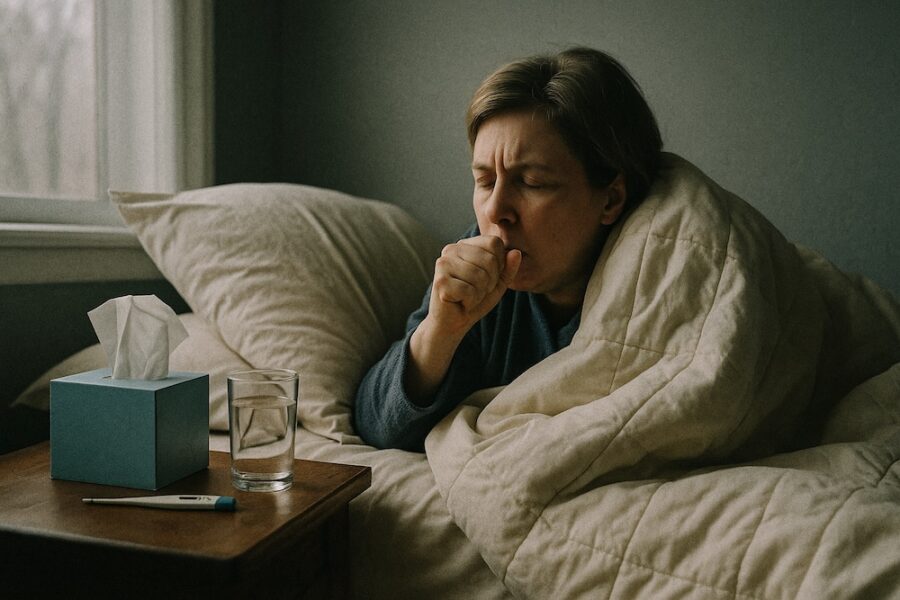
Flu season has arrived early. BBC News reports a sharp rise in infections, prompting ministers and public health officials to issue their annual directive: get vaccinated now. Hospitals are already bracing for a gruelling winter, and the message to the vulnerable is urgent.
Yet while the rhetoric is clear, the reality for those of us who cannot leave home is anything but. This winter, securing a flu or Covid vaccine as a housebound patient with muscular dystrophy has become a battle—one that has revealed not just a breakdown in local systems, but a troubling lack of national transparency.
A broken system for housebound flu vaccines
I am a registered patient at Victoria Medical Centre in Westminster, central London. Because I am housebound during the colder months, my vaccinations have always been delivered at home, usually efficiently by district nurses. Even in the fog and instability of the pandemic, this system held together. It was far from perfect, but it functioned.
In fact, this year initially seemed to get off to a promising start. At the end of September, a staff member from the GP surgery phoned me to say he was compiling a list of housebound patients identified as particularly vulnerable. He asked if I wanted the flu and Covid vaccines delivered at home. I said yes immediately. Yet since that conversation, there has been total silence.
The system has quietly disintegrated. The district nurses who visit me monthly have confirmed they are not delivering flu vaccines to housebound patients in my area this year. They tell me, anecdotally, that other housebound patients are also waiting, yet they cannot say how widespread the problem is. Nationally, there appears to be no public data distinguishing housebound vaccination rates from broader uptake figures.
What I can say with certainty is this: it is early December, and despite that initial phone call, I have received neither the flu nor the Covid vaccine. It is difficult to understand why housebound patients—arguably among the most vulnerable—appear to be at the back of the queue.
The bureaucracy loop: PCNs vs ICBs
For weeks I have tried to find out who is responsible for delivering vaccines to the housebound. Victoria Medical Centre tells me the South Westminster Primary Care Network (PCN) is in charge, but will not provide contact details. Repeated conversations with the Deputy Practice Manager have yielded nothing. The NHS North West London Integrated Care Board (ICB) insists the responsibility lies with NHS England. NHS England sends me back to the ICB.
I have written to the Clinical Director in charge of the local PCN and received no reply.
I reached out to the Patients Association, a national lobby group, who kindly phoned the practice’s enquiries line on my behalf. Even that yielded nothing.
The dysfunction runs so deep that even local government cannot fix it. Westminster Council’s public health department recently took up my case, formally raising it with my GP surgery as a public health issue. Yet even this high-level intervention has failed to deliver results. If the council cannot break the deadlock, what hope does a patient have?
It is a loop with no exit—a circular bureaucracy where accountability is so dispersed that nobody feels compelled to act. This would be frustrating in any context. During an early and virulent flu season, it is dangerous.
The challenge we face is the “unknown.” Beyond my own experience, and a handful of others in my immediate area, we simply do not know if this is a localised failure or a national blind spot. We lack data on how many housebound patients have been vaccinated, how home delivery is being coordinated, or whether local teams actually have the staffing to carry it out.
The NHS publishes winter vaccination uptake rates, but housebound patients are not broken out as a distinct category. Consequently, there has been no national reporting on potential failures in home-visit vaccinations this winter. My story might be an anomaly—or it might be the visible edge of a larger, unreported crisis. The absence of information is, in itself, a warning sign.
Labour’s NHS promise vs. reality
Wes Streeting, the Health Secretary, has repeatedly stated that his priority is keeping people out of A&E this winter. It is a sensible, necessary ambition. But that ambition is undermined when clinically vulnerable housebound people cannot access the most basic preventive care.
This year, Labour brought NHS England back under closer ministerial control. With that shift comes clearer political accountability. When the system works, credit belongs to ministers. When it fails, responsibility sits there too. I am not suggesting ministers are personally blocking home visits, but if their reforms result in a diffusion of responsibility rather than clarity, patients will feel the consequences first.
Prevention is the foundation of a functioning NHS. If the system cannot reliably vaccinate people who cannot leave their homes, its ability to cope with winter pressures is already compromised.
The personal risk of vaccine delays
The stakes for me are personal. I am extremely vulnerable to respiratory infections. My consultant at the Royal Brompton, a renowned chest hospital, has written explicitly to my GP confirming that I should receive the Covid vaccine despite tightened eligibility rules.
I received the Covid vaccine at home throughout the pandemic, and have had the flu jab every year of my adult life—often delivered by district nurses as my condition progressed.
Flu is not an abstract danger for me. In 2017, I lost my brother—who also had muscular dystrophy—to flu-related complications. I know how quickly things can deteriorate. These delays are not merely bureaucratic frustrations; they are moments of genuine risk.
While my elderly parents in Wales, 87, were vaccinated five weeks ago, I remain unprotected in central London. This contrast alone raises questions about the consistency of winter preparedness across the NHS.
But before those questions can be answered, we need something more fundamental: clarity. The government and NHS bodies must urgently publish housebound vaccination delivery plans and data on completion rates. Only then can we understand if hundreds, or thousands, are being left behind.
Labour promised competence. For housebound patients, the test is painfully simple: can the NHS reach those who cannot reach it? At the moment, the answer is far from clear.






John Cope
So I am not alone, my mum is 86 and is housebound, we have the same problems in Birmingham but nobody cares or helps, not my GP, MP,, or NHs,
Colin Hughes
John, thank you for sharing this — I’m really sorry your mum has been left in that position. Sadly, what you describe mirrors what far too many housebound families experience, in different parts of the country.
I hope she has now been able to receive her flu vaccine, even if far later than it should ever have been. No one who is housebound should have to fight to access something so basic.
I appreciate you taking the time to comment — it matters that these experiences are visible.