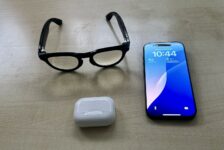



Apple is currently testing a new feature called Notification Forwarding as part of the iOS 26.3 beta. On the surface, it looks like a small system-level change. In reality, it points to a potentially significant shift in how iPhones interact with third-party wearables.
The setting is already visible in iOS 26.3 betas globally. Apple has said the feature exists to meet EU regulatory requirements, and current evidence suggests it is intended to be enabled first within the European Union once iOS 26.3 is publicly released — which is expected towards the end of January or early February.
For users in the UK, and elsewhere, that distinction matters.
Why iOS 26.3 Notification Forwarding exists
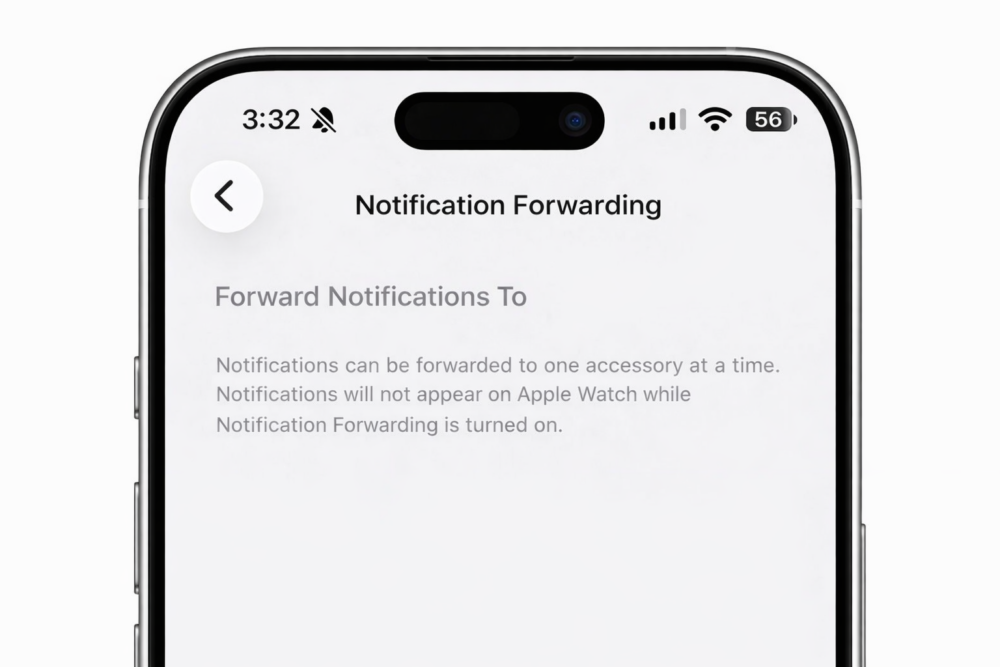
Notification Forwarding is closely linked to the EU’s Digital Markets Act (DMA). The legislation requires large “gatekeeper” platforms to open up deeper system access to third-party accessories, rather than reserving meaningful integration for their own products.
In practical terms, this means Apple must allow devices such as third-party smartwatches and smart glasses to receive richer notification data — not just a basic alert that something has happened.
Because the UK is no longer under EU jurisdiction, Apple may not enable this functionality in the UK when iOS 26.3 leaves beta. While the UK’s Competition and Markets Authority (CMA) has recently designated Apple as having Strategic Market Status, the specific rules that would mirror this EU requirement are still in the consultation phase. That has left British users in a temporary regulatory gap, despite the setting already appearing in test builds – as detailed in MacRumors’ reporting on Notification Forwarding in iOS 26.3
What this looks like in the real world
Until now, most third-party wearables connected to the iPhone receive little more than a notification ping. The content itself remains locked on the phone.
To give a real-world example: when my Ray-Ban Meta smart glasses ping for a BBC News alert, I know something has happened — but that’s where it ends. To find out what the notification actually says, I would need to pick up, unlock, and navigate my iPhone. That’s something I simply can’t do because of my disability.
If the alert is genuinely important — breaking news, an urgent update, something that matters — I’m aware of it in theory, but cut off from the information itself. The phone becomes a physical barrier rather than a gateway.
If Notification Forwarding works as intended once iOS 26.3 is released, the iPhone will be able to pass the full notification text directly to a wearable. Smart glasses or watches would then be able to read that information out immediately, without the phone ever being touched.
At this stage, it is also worth noting a significant trade-off in Apple’s implementation: it is a one-device system. If you enable forwarding to a third-party wearable, notifications will not appear on your Apple Watch. For many people, that forces an unnecessary choice between two different assistive technologies.
It is also worth being clear that most beta discussion so far has focused on the presence of the setting and the underlying framework, rather than confirmed, widespread reports of notifications being actively delivered to third-party wearables. At this stage, it remains groundwork rather than a finished experience.
Why accessibility matters here — regardless of intent
Apple has positioned Notification Forwarding as a regulatory response rather than an accessibility initiative. Even so, its most immediate and meaningful impact may be precisely there.
For many disabled people, “just pick up your phone” isn’t a minor inconvenience — it’s not an option.
For those of us with significant upper-limb impairments, voice-first wearables and smart glasses are not lifestyle accessories. They are tools for independence. If notifications are not delivered in a usable way, essential information remains trapped behind a screen we cannot physically access.
If fully realised, iOS 26.3 Notification Forwarding could turn a wearable into a genuinely hands-free information layer. It would remove the smartphone as a physical choke point and help ensure that interoperability translates into real-world access.
EU-only — or simply EU-first?
Apple has not said that Notification Forwarding will remain EU-only once iOS 26.3 is out of beta. The fact that the setting already appears globally suggests that broader groundwork may be in place.
That leaves room for optimism — but also for scrutiny
In my view, this is exactly the kind of feature that should not remain region-locked. Accessibility should not become a privilege determined by geography or regulatory boundaries.
For disabled people, interoperability isn’t about market competition. It’s about access to information, autonomy, and independence.
A constructive ask — to Apple and developers
To Apple: when iOS 26.3 is released, Notification Forwarding should be treated as more than a compliance exercise. This has the potential to be a meaningful accessibility capability, and it deserves serious consideration for wider, global availability.
And to third-party developers — including companies like Meta — this will only matter if it is implemented properly. Apple has introduced the AccessoryNotifications framework to support this work. When it becomes available outside the beta context, wearable makers need to be ready to adopt it fully, so that notifications are not just delivered, but genuinely actionable.
Opening the platform is only half the job. The ecosystem has to step through the door
Conclusion
iOS 26.3 Notification Forwarding may have emerged from regulation, but its significance goes far beyond compliance. It’s a reminder that seemingly small platform decisions can quietly remove — or reinforce — physical barriers.
When iOS 26.3 is publicly released, Apple will have a choice. It can treat Notification Forwarding as a narrowly scoped EU requirement, or it can recognise it as a meaningful accessibility capability and expand it more widely.
If Apple — and the wider ecosystem — are serious about inclusive technology, this is the kind of feature that deserves to travel.