

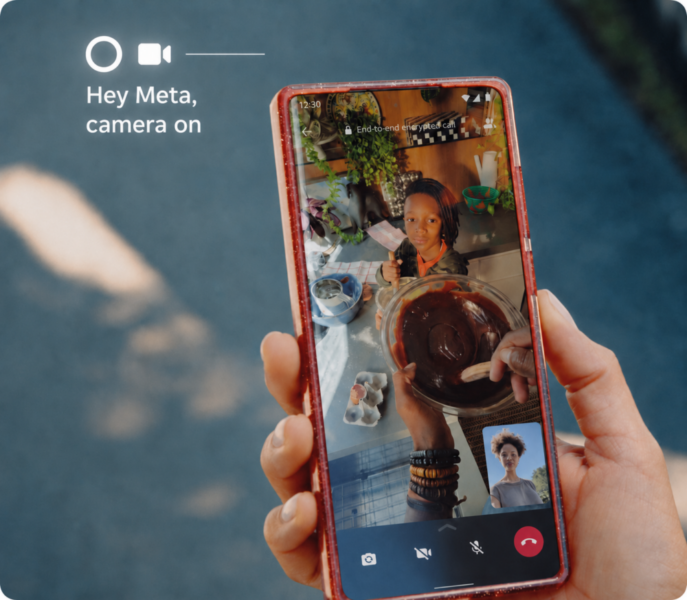
In May, shortly before Global Accessibility Awareness Day, Meta announced that it was bringing a new set of hands-free call controls to its AI glasses.
The company said people would be able to mute and unmute calls, turn their video on or off and hang up using Meta AI, without touching their phone or the glasses. The controls would work with calls on WhatsApp, Messenger, Instagram and Be My Eyes.
Those features have now reached my Ray-Ban Meta glasses in the UK, and I have had the opportunity to use them.
The supported commands include:
- “Hey Meta, mute.”
- “Hey Meta, unmute.”
- “Hey Meta, camera on.”
- “Hey Meta, camera off.”
- “Hey Meta, hang up.”
- “Hey Meta, end call.”
Meta now lists these commands in its official guidance for AI glasses.
They may sound like fairly ordinary additions. For me, they have changed some very basic aspects of using a telephone.
Hanging up on spam calls for the first time
I have a severe upper limb disability and cannot pick up a phone or press the red button on its screen.
That means starting a call with a voice command has never been enough. I also need to be able to control and end that call by voice.
For years, an unwanted call could leave me waiting for the other person to hang up. If I reached someone’s voicemail, I sometimes had no way to end the recording and had to wait for the mailbox to time out.
A spam caller could control when a conversation ended. I could not.
With my Meta glasses, I can now say, “Hey Meta, hang up.” The call ends immediately.
It is difficult to convey how important that small command feels after years of being unable to end calls on my own terms.
Most people will probably see it as a useful option when their hands are occupied. They may be cooking, carrying shopping or working with tools. For people with severe upper limb disabilities, it is more fundamental. It provides control over a basic communication function that touchscreens have often placed beyond our reach.
Sharing what I can see during WhatsApp calls
The camera controls have been equally useful.
I can call family and friends on WhatsApp and say, “Hey Meta, camera on.” They can then see my point of view through the camera in the glasses.
I do not have to hold a phone, position it or ask somebody else to point it for me. The camera is already where I need it, looking in the same direction as me.
I can show somebody what is happening in my flat. I can ask for help identifying something. I can share a view while I am outside or let friends and family experience a moment from my perspective.
When I have finished sharing, I can say, “Hey Meta, camera off.”
That final part is important. Accessibility is not only about being able to begin an action. It also means being able to stop it, reverse it or change it independently.
Before these voice controls arrived, turning on the point-of-view camera during a WhatsApp call required pressing a button on the arm of the glasses. That may be straightforward for most people, but it made the feature inaccessible to anyone who could not reach their face or press the control.
In my 2024 feature requests for Ray-Ban Meta smart glasses, I called specifically for commands such as “Hey Meta, hang up” and “Hey Meta, turn on video call”.
I returned to the issue in my Ray-Ban Meta Gen 2 review, arguing that voice control of calls and point-of-view video was necessary if the glasses were to function as a genuinely hands-free communication device.
Meta has now delivered both.
Muting a call without asking someone else
Muting and unmuting calls by voice is less dramatic, but it is still valuable.
There are times when I need to speak privately to my carer, deal with something happening in the background or pause a conversation without ending the call.
I can now say, “Hey Meta, mute”, deal with the interruption and then say, “Hey Meta, unmute” when I am ready to continue.
Once again, no touchscreen, physical button or assistance is required.
This is what effective accessibility often looks like. It does not always arrive as a specialist mode with an accessibility label attached. Sometimes it is a collection of well-designed mainstream controls that allows more people to use a product independently.
A long campaign for a simple command
I have been writing about voice-controlled call hang-up for nearly a decade.
In 2018, I asked why Siri could place a call but could not end one in Siri: Why do you keep me hanging on the telephone?.
I raised the issue repeatedly with Apple in articles, feedback and direct conversations. Apple eventually introduced Siri Call Hangup with iOS 16 in 2022, allowing people to end phone and FaceTime calls by saying, “Hey Siri, hang up”.
When Ray-Ban Meta glasses became capable of making calls, the same principle applied.
A hands-free device is not fully hands-free if voice can start an action but cannot control or end it. Voice-first technology needs voice-first controls throughout the experience.
I have raised these issues repeatedly over several years, both publicly and in conversations with Meta. It is particularly welcome to see those concerns reflected in the latest controls.
Meta’s wider accessibility work
Meta’s smart glasses have already received deserved attention for the help they can provide to blind and low-vision people.
The integration with Be My Eyes allows someone wearing the glasses to connect with a sighted volunteer who can see through the point-of-view camera. Meta has since expanded the service so that people can call trusted friends or family members and connect with trained representatives from organisations including Tesco, Sony, Amtrak and Hilton.
Detailed Responses can provide richer descriptions of the environment, including information about objects and surroundings. Meta has also opened its Wearables Device Access Toolkit to developers working on services such as OOrion and Aira.
These developments have considerable potential.
What is discussed less often, including in some of Meta’s own publicity, is how useful the glasses can be for people with severe upper limb disabilities who rely on voice control.
I cannot pick up a smartphone. Ray-Ban Meta glasses allow me to take photographs, record video, send WhatsApp messages, make calls and now manage those calls without handling a device.
They have removed barriers that smartphones never solved for me. In that respect, they really have been a game changer.
The new call controls strengthen that case because they address the less glamorous details that determine whether technology works in real life.
Samsung and Google enter the market
Meta will soon face much stronger competition.
On 22 July, Samsung and Google gave a fuller look at their forthcoming intelligent eyewear during Galaxy Unpacked in London.
The glasses have been developed with eyewear brands Gentle Monster and Warby Parker. Samsung says they will offer a lightweight design, a built-in camera, Gemini integration, up to nine hours of battery life and as many as seven additional charges from the case.
Announced functions include message summaries, live translation, navigation, contextual visual assistance, voice interaction and the ability to share the wearer’s point of view during a call. Some controls will also be available through gestures on a compatible Galaxy Watch 9.
There is a great deal to welcome in that announcement. Competition should lead to more choice, better hardware and faster development.
However, several accessibility questions remain.
Samsung and Google have not yet explained in sufficient detail whether every stage of a call can be managed entirely by voice. We do not know which functions will work equally well with an iPhone, which will require a Galaxy device or watch, how well Gemini will recognise atypical speech, or what dedicated physical and motor accessibility settings will be available.
The glasses are expected to launch in the autumn, so there is still time for those details to emerge.
For now, Meta remains ahead in one important respect. Its accessibility benefits are not confined to a presentation or product demonstration. Many of them are already available on glasses that people can buy and use today.
There is still work for Meta to do
Meta may remain ahead on smart glasses accessibility, but its work is far from finished.
I still want to see smart home control, including commands to open connected doors and control lights, blinds and other essential equipment. A friend who visited me recently was impressed when I used a Siri voice command to open my front door as we were leaving. He then asked whether I could do the same through my Meta glasses. Unfortunately, the answer is not yet. Adding that capability could make the glasses even more useful for people who cannot reach switches, phones or smart displays.
Messaging also needs further improvement to offer faster reply flows with fewer unnecessary confirmations.
Hands-free WhatsApp summaries and message recall are also on the way, allowing people to ask their glasses to catch them up on conversations or retrieve particular details without reaching for a phone. I am now waiting for Meta to confirm when the feature will reach the UK. I previously pressed Apple on a similar limitation, and it later introduced authentication through AirPods so Siri could access older messages rather than being restricted to newly arrived notifications.
Wake-word reliability and the recognition of disabled people’s speech must also remain priorities going forward. Voice control is only genuinely accessible when it works consistently, including for people whose speech may differ from the voices on which these systems have traditionally been trained.
Meta should also be careful not to place accessibility-centred functions behind subscriptions. As I recently argued in Meta’s Conversation Focus paywall crosses a line, features designed to make conversation easier should not become premium extras available only to people who can afford recurring fees.
Those are significant requests, and I will continue making them.
But accessibility advocacy should acknowledge progress as clearly as it identifies failure.
Meta announced these call controls in May. It has rolled them out to the UK. I have tested them, and they work.
I can end spam calls. I can mute and unmute conversations. I can share my point of view with family and friends and decide when the camera is turned off.
I can do all of it with my voice.
That is a really positive accessibility story, and Meta deserves credit for it.