
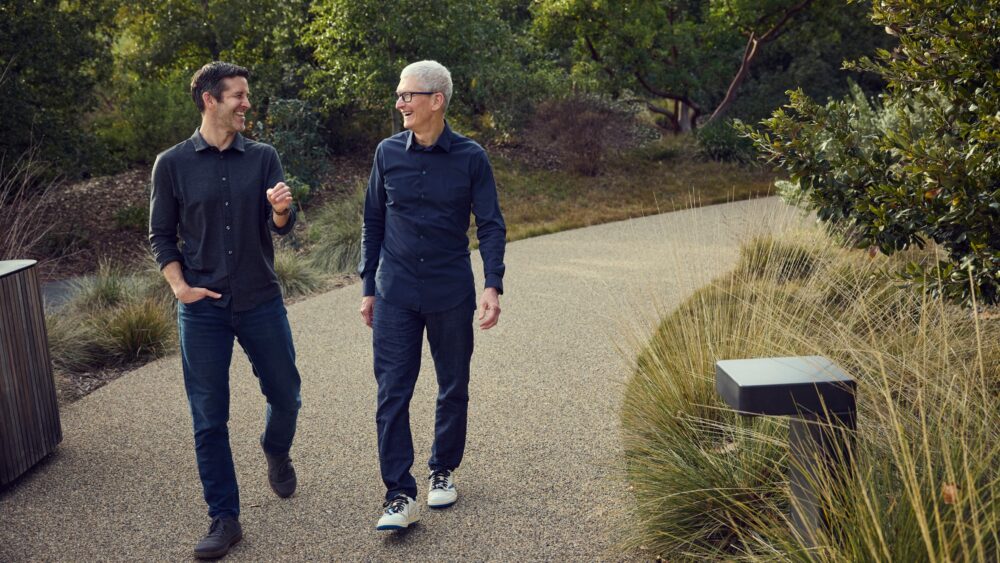
Tim Cook has written a farewell letter to Apple staff on his final day as CEO, reflecting on 15 years at the top of one of the world’s most influential technology companies.
In it, Cook says he is most proud of “what an annual report could never capture”.
Well, Tim, since you mention annual reports, here is one you probably weren’t expecting.
Your accessibility end-of-term report.
I should say at the outset that Apple’s commitment to accessibility did not begin with Tim Cook. VoiceOver, for example, predates his time as chief executive, and accessibility was already more deeply embedded at Apple than at many technology companies when he took over from Steve Jobs in 2011.
But during Cook’s 15 years as CEO, that commitment became broader, more visible and, in several important areas, more ambitious.
I have spent much of Cook’s tenure using Apple products, writing about their accessibility and campaigning for changes that would give people with severe physical disabilities greater independence.
Quite a few boxes on my wish list eventually acquired ticks.
So, report cards out. No looking at the person next to you.
Accessibility culture: A
One of Cook’s most important achievements is that accessibility has remained part of Apple’s mainstream product philosophy.
That matters.
The best accessible technology is often not specialist disability equipment. It is the same iPhone, Mac, Apple Watch or pair of AirPods that millions of other people are buying, with accessibility built into the operating system and hardware.
During the Cook years, I campaigned for automatic call answering on the iPhone, followed by auto-answer on Apple Watch. I wanted to be able to switch auto-answer on and off by voice. That arrived too.
Some improvements have become so useful that I almost take them for granted. I am still grateful that Face ID works for me even when I am wearing my ventilator mask, thanks to Apple’s Face ID with a Mask functionality. That has made a real difference to me for years, and it is something my Pixel phone still cannot match.
Then came Siri call hang-up, something I had been campaigning for because although pressing a red button to end a call is trivial for most people, it is impossible for somebody who cannot pick up their phone or touch the screen. The Register had highlighted the absurdity in 2021: Siri could answer my calls, but still could not hang them up.
In 2023 came better automation of auto-answer calls through Shortcuts and another small but important change: AirPods could act as trusted authentication for Siri requests. That meant I was no longer constantly told I needed to unlock my iPhone before Siri would read messages or access other personal information. Matthew Cassinelli wrote about the significance of that change.
In 2024, Apple added Vocal Shortcuts and Listen for Atypical Speech, bringing personalised speech recognition to people whose voices do not always fit the assumptions conventional speech recognition makes.
I am not suggesting these features appeared because I asked for them. Apple has its own accessibility teams, disabled employees and customers around the world making similar arguments.
But there is something satisfying about spending years saying, “Why can’t my iPhone do this?” and eventually being able to say, “Ah. Now it can.”
Teacher’s comment: plenty of ticks on the sheet.
Voice Control: B for the idea, C for recent effort
Voice Control arrived in 2019 and, for people like me who cannot rely on a keyboard, mouse or touchscreen, it was an important moment.
Apple had created a built-in way to control a Mac, iPhone or iPad almost entirely by voice.
No specialist package to buy. No additional subscription. It came with the device.
Excellent start to the course.
Apple has not completely ignored it. In 2024, Voice Control gained better support for complex vocabulary and custom words, including a long-awaited improvement in handling proper nouns.
Unfortunately, the bigger picture is less impressive.
I wrote in The Register in 2023 about Voice Control’s stubborn shortcomings, particularly its dictation accuracy, grammar, handling of proper nouns and failure to learn sufficiently from corrections.
Three years later, the central concern remains.
AI dictation has raced ahead. I now use systems capable of understanding hesitations and self-corrections, dealing with less-than-perfect speech and turning it into clean, accurately formatted text.
Against that backdrop, Voice Control increasingly feels like technology from an earlier generation.
That is frustrating precisely because Apple got so much right in the first place.
Teacher’s comment: considerable ability, but capable of much better.
Siri: B-
My relationship with Siri during the Cook years has been complicated.
At its best, Siri has been transformative.
Siri call hang-up is a perfect example. For the first time, I could make a call and end it without needing somebody else to press the button for me.
Siri and Apple’s smart-home ecosystem have also allowed me to control things around my home by voice that would otherwise require physical assistance.
AirPods authentication for Siri requests removed another unnecessary physical barrier.
These are not minor conveniences.
But Siri has also spent an extraordinary amount of the Cook era feeling as though the really intelligent version is arriving next year.
And then next year.
And possibly the year after that.
At times, following Siri’s development has felt slightly like waiting for a tradesperson who insists they are definitely coming on Tuesday.
Apple’s newer AI-powered dictation looks promising, but my question remains the same: will that intelligence reach Voice Control and the people who actually depend on voice access, rather than remaining concentrated in mainstream keyboard dictation?
Apple Watch: must try harder
And then we come to the pupil I have had to speak to after class.
Apple Watch is an extraordinary piece of technology, packed with communications, health and safety features.
Yet I still cannot reliably summon Siri on Apple Watch without physical movement.
Apple has developed AssistiveTouch, Double Tap, wrist gestures and other clever alternatives to touching the screen. They are genuinely useful for some disabled people.
But they still assume that the wearer can raise a wrist, move a hand, pinch fingers or perform some other piece of wrist acrobatics before Siri will listen.
Some of us cannot.
I made this case in The Register when the Apple Watch turned 10. The problem is remarkably simple: after more than a decade of Apple Watch, “raise your wrist” still isn’t an accessibility strategy for somebody who cannot raise their wrist.
Teacher’s comment: we have discussed this before. Several times.
John Ternus, I hope you are taking notes.
Overall grade: B+
That may surprise people who have read some of my more frustrated writing about Apple.
But perspective matters.
Tim Cook leaves accessibility at Apple considerably better than he found it.
I can look back at a list of things I once asked Apple to change and see tick after tick. Some have made modest differences. Others have changed what I can do independently every day.
That is a significant legacy.
But Cook also leaves some remarkably old homework.
Voice Control needs to enter the AI era. Dictation needs to become more accurate, contextual and adaptive. Siri still has unfinished business. And Apple Watch needs to stop assuming everyone wearing one can perform the physical gestures its designers expect.
Cook is not actually leaving Apple. He becomes executive chairman as John Ternus takes over as chief executive.
So perhaps this isn’t quite goodbye.
Tim, enjoy the chairman’s office.
But before you clear the CEO’s desk, could you leave the Voice Control folder and that Apple Watch Siri problem somewhere John can’t possibly miss them?
Preferably on top of the desk, rather than in whatever drawer Siri’s promised transformation has been sitting in.
Final mark: B+. Very good work. Considerable progress. Some important work still unfinished.