

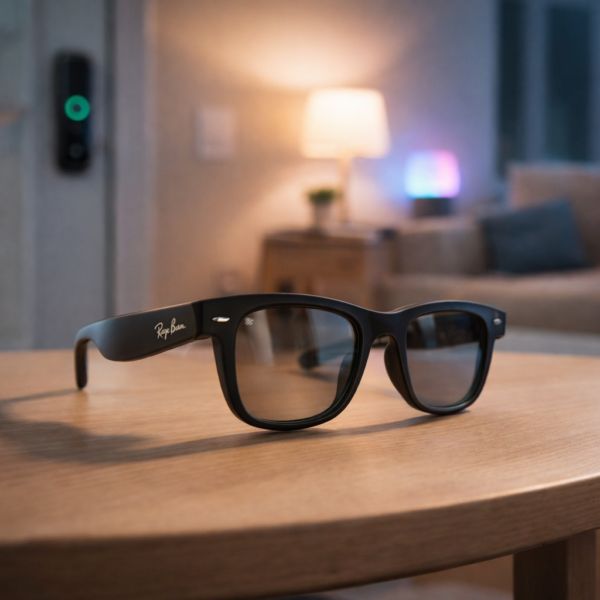
Ray-Ban Meta smart glasses are often presented as content tools — devices for creators capturing everyday moments.
That framing is far too narrow.
If Meta is serious about ambient computing and long-term mass adoption, then Ray-Ban Meta smart home control must become central to the product’s evolution – first by voice, and ultimately through the EMG Neural Band being developed in collaboration with the University of Utah.
This is not about novelty. It is about autonomy.
I have argued repeatedly on Aestumanda that the glasses should integrate with smart home systems — including the ability to open my own front door hands-free. The case has only grown stronger.
From lifestyle accessory to assistive infrastructure
A recent LinkedIn post from Bob Carter, CEO of University of Utah Health, highlighted collaboration with Meta on an accessible electromyography (EMG) wristband capable of detecting muscle signals from the forearm.
The example was simple: turning on a light.
For many people, that is trivial. For someone living with muscular dystrophy, motor neurone disease, or paralysis, it can require layers of workaround technology.
I have long argued that the smart home is not a luxury for the lazy. It is a prosthetic for the paralysed.
Today I rely primarily on voice assistants to control lighting, heating and entry systems. That works — most of the time. But voice is not universally reliable.
- What happens if the internet drops?
- What if speech is impaired by fatigue?
- What if you are on a confidential call?
- What if you simply do not want to issue a wake word in public?
Accessibility works best when it is layered. Voice should be one modality, not the only one.
For context on the EMG collaboration, see the University of Utah’s announcement on the EMG research partnership with Meta, which outlines the early research goal of enabling people with paralysis to interact more independently with the world. The project explores how electromyography (EMG) signals from the forearm can be translated into digital commands, potentially allowing subtle muscle intent to control devices without traditional physical input.
The “Look and Click” revolution
Meta’s glasses already support multimodal AI. They know what I am looking at. They respond to voice. They understand context.
The Neural Band introduces something more subtle: detection of motor intent, even where visible movement is minimal.
Here is the workflow I am proposing to Meta’s engineering teams:
- Gaze – I look at my front door smart lock through my Ray-Ban Meta glasses.
- Recognition – The glasses identify the object using visual AI.
- Intent – I perform a tiny wrist “click” gesture detected by the Neural Band.
- Action – The door unlocks.
No wake word.
No phone in hand.
No reaching for a switch.
Just direct interaction with the physical environment.
If the Neural Band can help a quadriplegic skier steer a TetraSki down a mountain, it is reasonable to expect it could steer a smart home.
Voice first, gesture next
Voice control alone would already transform the usefulness of Ray-Ban Meta glasses if properly integrated with smart home ecosystems.
Meta should prioritise:
- Matter compatibility
- HomeKit integration
- Google Home interoperability
- Secure smart lock support
Just as importantly, native smart home control within the glasses would reduce the need for additional wearable hardware. Users would not have to rely on separate devices such as AirPods or a smartwatch simply to issue voice commands discreetly. The glasses themselves could become the primary ambient interface.
Only then does the Neural Band become the next logical layer — adding resilience when voice is unavailable or impractical.
For disabled people, resilience is not a design flourish. It is the difference between independence and isolation.
Beyond content creation
Ray-Ban Meta glasses are currently marketed heavily around media capture and social sharing.
That is understandable. But it risks underplaying the product’s broader potential.
Smart home integration would reposition the glasses as:
- A persistent ambient interface
- A home controller
- A mobility enabler
- A platform for layered accessibility
They would no longer be perceived primarily as a youth product. They would become infrastructure.
Competitive pressure is increasing
Competition in smart glasses is accelerating. Google and Samsung are advancing their own platforms, and Apple is widely reported to be working on its own smart glasses platform, with multiple industry analysts suggesting an unveiling could come as early as this year.
If that materialises, Apple would have a structural advantage: deep integration with its existing ecosystem. HomeKit, Siri and the broader Apple smart home framework are already mature. Extending that capability to glasses would be technically and commercially straightforward.
Meta, by contrast, has an opportunity — but not an automatic advantage.
If Ray-Ban Meta glasses are to compete in a market where ecosystem integration will matter more than novelty, smart home control cannot remain peripheral. It must become core.
In that context, accelerating voice-based smart home integration — and laying the groundwork for Neural Band gesture control — would not simply be an accessibility upgrade. It would be strategic positioning.
Conclusion
Ray-Ban Meta smart glasses do not need more novelty features.
They need purpose.
Ray-Ban Meta smart home control — by voice now and Neural Band as the next layer — should be treated as core functionality, not an experiment.
If Meta wants these glasses to become everyday computing devices, they must extend beyond capture and entertainment into practical autonomy.
Smart home integration would not be a niche accessibility feature. It would redefine what smart glasses are for.
The technology is already within reach.
What remains is the decision to prioritise it.