

Today, while I was out in London, I used a new feature in software version 127 of my Ray-Ban Meta smart glasses to make a WhatsApp video call to my friend Halina.
I simply said: “Hey Meta, video call Halina on WhatsApp.”
The call began without me touching my phone or the glasses. I could show her where I was and share what I was seeing as I moved around the city.
For most people, this might sound like a convenient alternative to holding up a smartphone. For me, it was something I could not otherwise have done. I cannot pick up a phone, point its camera or operate the screen conventionally. The camera and completely hands-free controls made the call possible.
The feature had arrived only yesterday, yet it immediately showed why camera-equipped smart glasses can offer disabled people far more than convenience.
These are the same glasses now being described as “pervert glasses” and “mass surveillance predator glasses”. If I lost access to them, whether through a ban or growing social stigma, I would feel less safe, less connected and less independent.
That does not place them beyond criticism or regulation. It does mean the debate should not begin and end with their worst possible use.
A backlash rooted in real harm
The backlash against camera-equipped smart glasses has grown sharply in recent months.
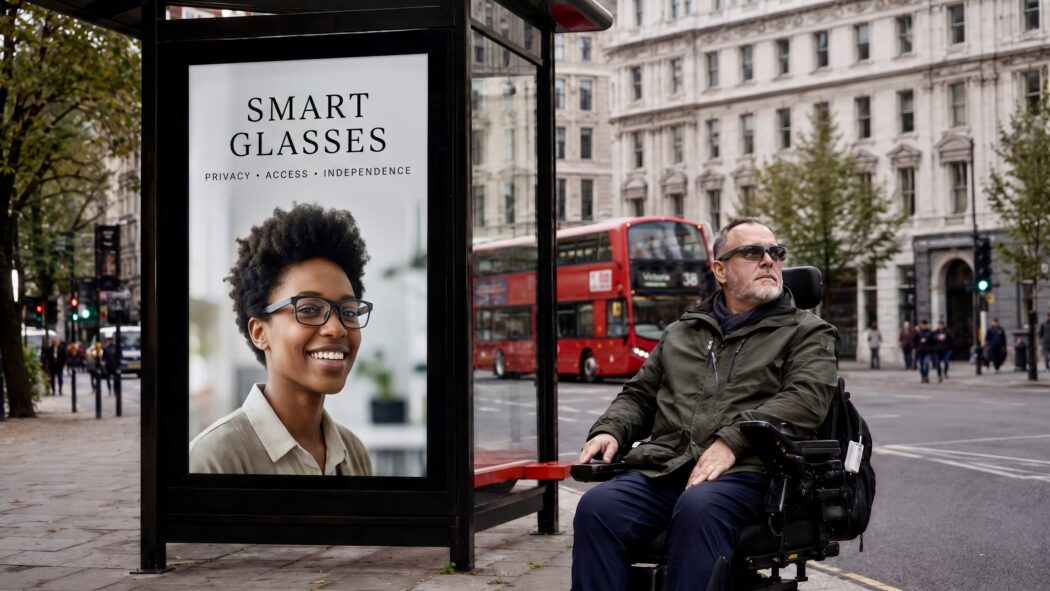
Activists have altered Meta advertisements in London, New York and Washington, while social media posts describing the glasses as predatory or inherently sinister have attracted tens of thousands of reactions. The Verge has documented the growing backlash, including calls to shame wearers publicly and treat anyone wearing smart glasses as a potential threat.
That rhetoric has also been amplified by high-profile commentators with large social media audiences. In one widely shared post, political commentator Marina Purkiss said that no amount of advertising would make people view Meta’s smart glasses as anything other than “predator glasses”.
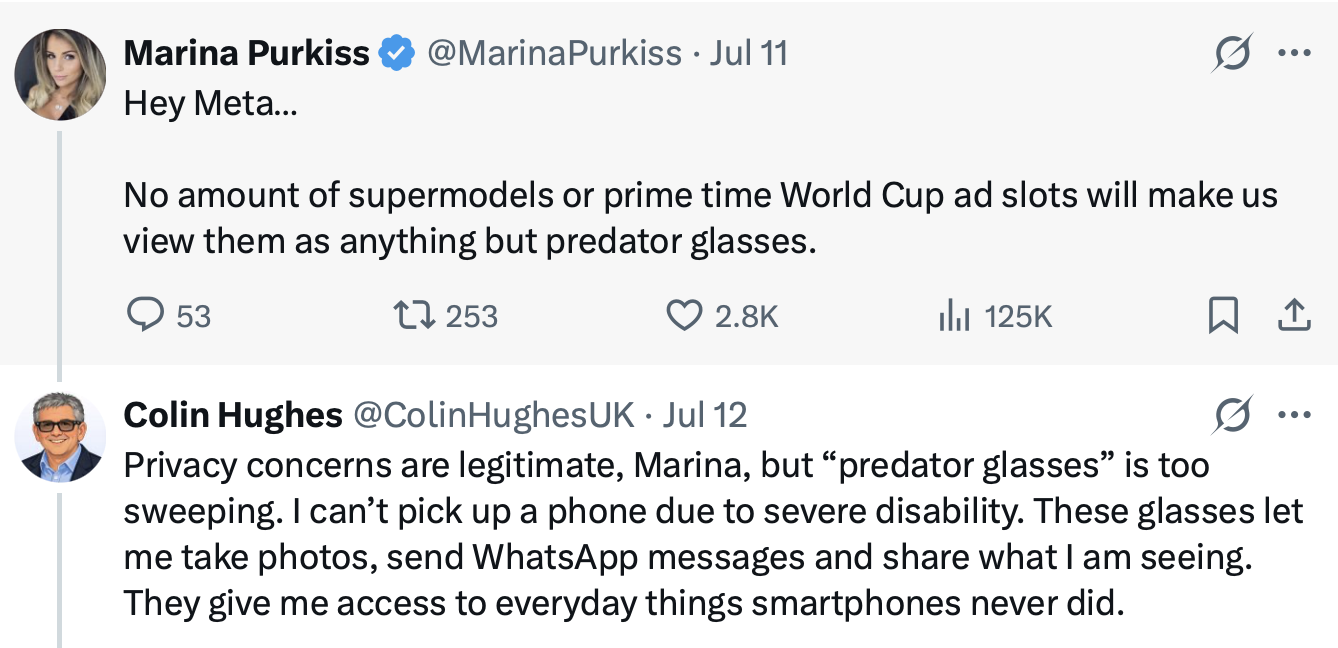
The language is deliberately provocative, but the concerns behind it cannot be dismissed.
Some men have used smart glasses to record themselves approaching women, then uploaded the footage without the women’s knowledge or consent. Others have filmed strangers, service workers and vulnerable people for prank, humiliation or so-called pickup content.
Instagram has said it will remove some footage where smart glasses have been used to harass or take advantage of people. However, The Verge has rightly questioned how such a policy will be defined and enforced, and whether people who discover themselves in footage will have a clear route to demand its removal.
The Guardian has published several forceful criticisms of Meta’s glasses. After wearing them for a month, Elle Hunt described how easy it was to photograph people without attracting their attention. Other Guardian commentary has focused on the risks to women and children, including footage being repurposed through generative AI.
These are serious matters.
A camera worn on somebody’s face is different from a phone held visibly in front of them. People have learnt to recognise when a phone is pointed in their direction. They do not yet instinctively inspect a pair of glasses for a small recording light.
Women, children, workers and members of the public should not have to accept harassment, humiliation or covert recording as the unavoidable price of technological progress.
Meta also has a trust problem of its own making. Reports that it has explored facial recognition and more continuous forms of sensing, alongside concerns about how recordings are handled, have made many people wary of accepting its assurances at face value. A small white light cannot carry the entire burden of privacy when confidence in the company behind it is already fragile.
What the debate fails to see
Yet much of the argument treats the benefits of smart glasses as trivial.
They are not trivial to me.
I cannot hold a smartphone, raise it to take a photograph or reach across its screen to operate the controls. My Ray-Ban Meta glasses allow me to make calls, listen to messages, communicate through WhatsApp, take photographs and record video without using my hands.
During a video call, I can show family and friends what I am looking at. I can mute and unmute myself, switch the camera off and manage the call without asking somebody else to intervene.
Most people perform these tasks repeatedly without giving them a second thought. Their importance to me lies precisely in their ordinariness.
I could ask another person to operate my phone. That misses the point. Accessible technology turns assistance from a constant requirement into a choice.
My disability is different from that of a blind or partially sighted person, but the underlying principle is the same. A camera mounted at eye level can read text, identify objects, describe surroundings and connect the wearer to a sighted volunteer while leaving both hands free.
Following The Guardian’s critical review, disabled readers and organisations offered a very different account. They described smart glasses being used to read bills, identify buses, follow cooking instructions, explore museums and provide live captions for people with hearing loss.
The technology is imperfect. Voice recognition fails. AI descriptions can be inaccurate. Connections drop and features do not always work as promised.
But imperfect accessibility can still be valuable accessibility.
The ease with which some commentators dismiss these benefits as minimal shows how readily mainstream discussion overlooks experiences beyond their own.
For me, hands-free is not merely convenient
Smart glasses are often discussed as lifestyle gadgets for influencers, tourists and content creators. That may be how Meta markets them, but it is not the whole story.
For disabled people who cannot reliably use a touchscreen, hold a camera or manipulate small controls, hands-free access changes the nature of the product.
The open-ear speakers allow me to hear calls and messages without wearing headphones that isolate me from what is happening around me. The microphones allow me to dictate messages, make calls, and even hang up spam calls. The camera lets me capture something from my own physical perspective rather than relying on another person to decide what should be photographed.
My Ray-Ban Meta glasses have also allowed me, for the first time, to become the family photographer rather than simply appearing in photographs taken by somebody else.
After more than three years apart during the Covid pandemic, I recorded the poignant moment my elderly parents walked into my living room.
More recently, I photographed my goddaughter’s graduation celebration in a restaurant.
I was not spying on strangers or invading anyone’s privacy. I was capturing precious family moments and other important occasions in the only way available to me.
The glasses help me stay connected, share what is happening around me and document access problems when recording is appropriate and lawful. They also make me feel safer by giving me another way to contact somebody without needing to reach a phone.
None of this excuses filming another person without consent. It explains why removing the camera, banning the whole device or making wearers afraid to use it would have consequences that extend far beyond social media content.
Stigma can become a ban of its own
I suspect I speak for many disabled people when I say we are becoming tired of the increasingly negative portrayal of AI tools that can be vital to our independence.
Calling smart glasses “pervert glasses” may draw attention to genuine misuse, but it also collapses the distinction between an abusive wearer, an inadequately designed product and everyone who uses the technology.
A blind person looking towards a supermarket shelf may be asking AI to identify a product, not filming another shopper.
A disabled person wearing smart glasses on a train may be listening to a message, listening to a podcast, or waiting for a call.
Someone in a museum may be asking the glasses to describe an exhibit.
Yet once the device itself becomes a symbol of predatory behaviour, every wearer risks being treated with suspicion.
Stigma can restrict access before any government passes a law. Disabled people may feel unable to wear the glasses in public. Businesses may impose broad prohibitions. Manufacturers may retreat from camera-based accessibility because the reputational risk appears too great.
Restrictions are already emerging in some courts, on cruise ships and at events. DEF CON, for example, has banned smart glasses with recording capabilities from its 2026 conference, including pairs fitted with prescription lenses. Some restrictions are understandable, but policies that ban the entire device can also prevent access to calls, messages, audio and other functions that do not involve recording.
The important distinction is not between people who wear smart glasses and those who do not.
It is between legitimate use and misuse.
Privacy is also a technical design problem
The debate is too often presented as a choice between tolerating covert recording and stripping smart glasses of photography and video altogether. There are better options.
Meta says its second-generation glasses disable the camera if the recording light is covered. It has also announced a software update intended to detect when the light has been physically tampered with or destroyed, and says it is removing advertisements for services designed to defeat the safeguard. That response is welcome, although stronger protection should have been built in from the outset. It shows that privacy risks can be reduced through design rather than addressed only through bans.
Writing for 9to5Mac, Ben Lovejoy argued that Apple’s as-yet-unannounced smart glasses would lose much of their usefulness without photography and video recording. Instead, he proposed a brighter recording light that remains visible in sunlight and audible signals when recording starts and stops. The aim would be to make covert recording difficult and conspicuous.
That is a more constructive approach than either dismissing privacy concerns or removing functions that may be valuable to disabled people. However, Lovejoy also suggested requiring a spoken command before recording. Some disabled people cannot speak, while others have speech that voice assistants do not recognise reliably.
Privacy safeguards must work regardless of the control method used. A clear outward-facing light, and where appropriate an audible signal, should activate whether recording begins through voice, touch, or another accessible control.
Companies must explain clearly where images and audio are processed, what data leaves the glasses, how long it is retained and whether it may be used to train AI systems. Manufacturers should prioritise processing on the glasses or a connected phone, even where that requires more capable and potentially more expensive hardware.
Facial recognition is not currently available on Meta’s smart glasses, but reports that the company explored an unreleased system called NameTag have intensified concerns about where the technology could lead. I do not believe smart glasses should be able to identify strangers in public. There may be a small number of carefully controlled assistive uses, such as helping some people with dementia recognise family members or carers, but these would require clear consent and should not become a route to general-purpose facial recognition.
No safeguard will prevent every abuse. The realistic objective is to make covert recording harder, more visible and easier to address, while preserving legitimate and assistive uses.
Regulate the harm, not the independence
Smart glasses need effective rules.
Platforms should remove exploitative footage quickly and provide a straightforward process through which people can report images or videos captured without their knowledge.
Accounts repeatedly used to harass or humiliate people should face firm sanctions. Where conduct amounts to stalking, blackmail, sexual abuse or another criminal offence, it should be treated accordingly.
Clear restrictions are justified in changing rooms, medical settings, courtrooms and other places where expectations of privacy are especially high.
But governments, venues and companies should distinguish between recording and the many functions that do not involve recording.
They should also involve disabled people before deciding how camera-equipped wearables may be used. A disability impact assessment should be standard whenever regulators or organisations consider restrictions.
This tension was identified well before the current backlash. In 2021, researchers Sarah Woodin and Arthur Theil published Regulating Personal Cameras for Disabled People and People with Deafblindness, examining how rules governing personal cameras could affect disabled people, particularly people with deafblindness. They argued that privacy policy, assistive technology and accessible design could not sensibly be considered in isolation.
That principle is even more relevant now.
Accessibility cannot be used as an excuse for harassment or irresponsible data practices. Privacy concerns cannot be used as an excuse for excluding disabled people from mainstream technology.
Both require protection.
Privacy and independence are not opposing values
I am not asking anybody to trust Meta uncritically. I do not.
I am not asking women, workers, parents or members of the public to accept being recorded without their knowledge because smart glasses may also help disabled people.
I am asking for a more intelligent debate.
Today, I told my glasses to call a friend and we had a video conversation while I showed her where I was in London, just as other people do on their smartphones. Nobody was spied on. Nobody’s privacy was invaded. A piece of mainstream technology simply allowed me to do something that most people take for granted.
The current backlash too often takes the most abusive use of smart glasses and presents it as their entire purpose. That is neither accurate nor fair.
Hold Meta and other manufacturers accountable. Demand better safeguards. Reject general-purpose facial recognition, demand transparency over data collection and act firmly against covert filming.
But listen to disabled people before branding every wearer a predator or deciding that these tools have little value.
We should not have to choose between privacy and independence.
We should insist on both.