


The arrival of a new generation of hands-free smart locks, such as the Aqara U400, is one of those moments where a feature framed as convenience quietly reveals something much more important.
Using Ultra Wideband (UWB) and Apple Home Key, the lock can unlock automatically as you approach with an iPhone or Apple Watch. It represents a shift toward Zero-UI interaction: there is no tapping, no Face ID prompt, no voice command, and no app interaction. You simply arrive at your front door, and it opens.
For some people, that’s a nice quality-of-life upgrade. For others, it’s a glimpse of what truly accessible smart homes could look like.
Why hands-free automation matters for accessibility
Smart home accessibility is still too often reduced to voice control. Voice assistants have undoubtedly helped many people, but they are not a universal solution.
Some disabled people have atypical speech, weak speech, or no speech at all. Others experience fatigue, breathlessness, or inconsistency that makes repeated voice commands unreliable. Even beyond the physical effort, there is the cognitive load: the mental tax of remembering specific phrasing or navigating a screen while managing other tasks.
Touch-based control is even more limited. For disabled people with severe upper-limb disabilities, touch-screen interfaces are often entirely unusable. Precise gestures, small buttons, and time-sensitive “swipe to unlock” prompts can be absolute barriers to entry.
The most powerful smart home experiences are those where nothing is required of the user. Things simply happen when they need to happen. The Aqara U400 is significant because it proves that security and independence can exist without speaking, tapping, or needing manual dexterity.
The current reality: Voice as a lifeline
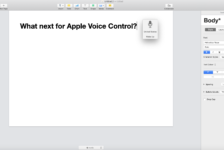
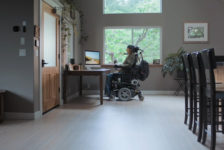
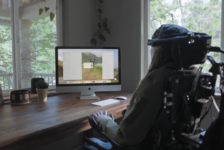
Before we look at what UWB changes, it is important to recognise how far we’ve come. For years, I have relied on voice technology to maintain my independence. In this video I produced with Ben Lovejoy from 9to5Mac, you can see how HomeKit and Siri act as a vital lifeline for me—enabling me to open doors, control my environment, and stay safe.
But as life-changing as voice control is, the Aqara U400 represents the next logical step. While the video shows me explicitly commanding the door to open, UWB technology allows the door to “know” I’m there without me having to say a word.
The Aqara U400 as a signal, not just a product
The Aqara U400 represents a newer class of technology that uses Ultra Wideband to recognise proximity and unlock automatically for a specific person. Apple is clearly comfortable with this model of interaction because it is:
• Personal: It knows who is at the door.
• Secure: It uses encrypted, short-range signals.
• Invisible: It works in the background without user intervention.
• Reliable: It responds to you, not just to movement.
If this “approach-to-trigger” logic works at the front door using a wearable device like the Apple Watch, the obvious question is: why does this thinking stop at the threshold?
Where today’s smart homes fall down
Inside the home, most automation still relies on motion or presence sensors. These tools are blunt. They detect someone, not who.
For disabled people who share their homes with support workers, this lack of identity awareness is a constant friction point. Lights or music might trigger for a carer when the disabled resident wants the them off. Current systems struggle with multi-occupancy because they lack the “identity” that a UWB wearable provides.
Why Ultra Wideband changes the equation
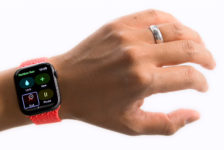
Ultra Wideband offers precise distance and direction awareness. Imagine wearing an Apple Watch—the ultimate passive wearable controller—and entering the living room. Because the system knows it is you, it can adjust your specific chair’s position, set your preferred lighting, and adjust the thermostat—all without affecting anyone else in the room.
No voice command. No button press. No accidental triggers from a carer walking past. For accessibility, this move from “reactive” to “context-aware” automation, triggered simply by the presence of a wearable, is a game-changer.
A necessary hardware reality check
It’s important to be precise about where Apple currently is. While Ultra Wideband is present across Apple’s ecosystem, the HomePod Mini still uses the original first-generation UWB (U1) chip, not the newer UWB 2 chip found in recent iPhones and Apple Watches. U2 offers greater range and precision.
For this vision to work inside the home, we need stationary “anchors” — like a future HomePod Mini 2 or dedicated wall-plugs — equipped with UWB 2. These anchors would provide the technical foundation for reliable, room-level, identity-aware automation. Today’s limitation is less about what is theoretically possible and more about waiting for the infrastructure of the home to catch up to the device in your pocket.
The technology exists — the platform does not (yet)
Apple already uses Ultra Wideband for spatial awareness and Precision Finding. The Aqara U400 shows Apple is comfortable deploying UWB in high-trust, opt-in scenarios where identity matters.
There are legitimate concerns around privacy, and Apple has good reasons to be cautious. But extending the same principles used at the front door into the smart home — with clear user control and consent — could unlock enormous accessibility benefits.
A glimpse of what could come next
Hands-free smart locks are a signal that smart homes can move beyond commands and towards context.
For disabled people in particular, the difference between telling a home what to do and having it understand what’s needed is the difference between assistance and independence. The Aqara U400 may be a door lock, but it quietly points to a future where technology is truly inclusive because it is truly invisible.
The question now is whether Apple is willing to let the rest of the smart home follow through.
Takeaway: Hands-free smart locks prove that “Zero-UI” automation is already possible. The opportunity now is to move this identity-aware technology beyond the front door to reduce the physical and cognitive load of daily living.