
Most smart glasses reviews start with the camera, the AI, the speakers or the battery.
This one has to start with my nose.
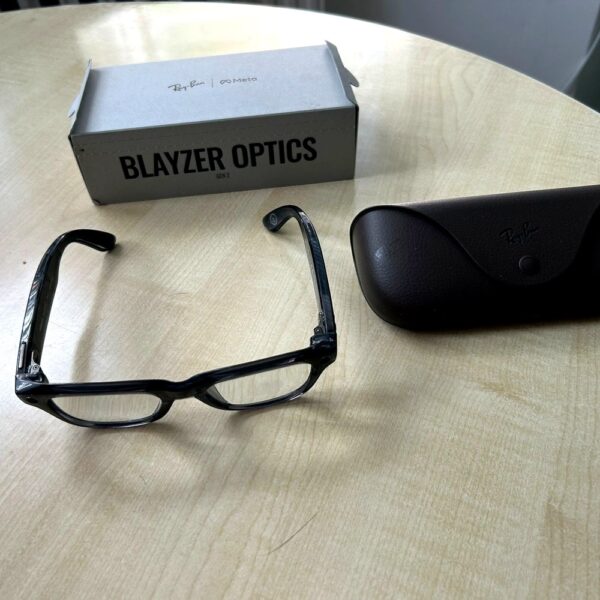
For context, the Ray-Ban Meta Blayzer Optics are part of a newer, prescription-first range of smart glasses designed specifically to look and function like standard daily eyewear, rather than tech accessories.
That is not as trivial as it sounds. If ordinary glasses slip, they become irritating. If prescription smart glasses slip, the whole product starts to fail. The lenses sit in the wrong place. The speakers move out of position. The camera angle changes. The wearer keeps having to push them back up.
For me, that last part is not an option. Because of my disability, I cannot simply reach up and reposition a pair of glasses every few minutes. So fit is not a comfort detail. It decides whether the product works.
That is why the Ray-Ban Meta Blayzer Optics are more interesting than they first appear.
They are not a dramatic reinvention of smart glasses. They do not have a display. They do not make Meta AI suddenly feel finished. In most respects, they are familiar Ray-Ban Meta Gen 2 technology placed inside a new optical-first frame.
But the frame is the point.
What the Blayzer Optics are
The Ray-Ban Meta Blayzer Optics are part of Meta and EssilorLuxottica’s newer prescription-focused smart glasses range. The Blayzer is a rectangular frame, while the Scriber has a rounder shape. Both are aimed at people who wear glasses every day, not only people who want smart sunglasses for the occasional walk or holiday.
The important difference is physical. The Blayzer Optics have over-extension hinges, interchangeable nose pads and optician-adjustable temple tips. They are also designed to support a wider range of prescriptions, including progressive lenses and Transitions through optical retailers.
They are only slightly lighter than the standard Ray-Ban Meta Gen 2 Wayfarer. Meta lists the Gen 2 Wayfarer at 51g for the standard size and 53g for the large, while the Blayzer Optics are around 49g in the standard size. On paper, that is a small difference. On the face, combined with the slimmer optical frame and better adjustment, it is enough to make them feel less bulky and more like ordinary glasses.
The technology is broadly the same as Ray-Ban Meta Gen 2. You get a 12MP camera, 3K video capture, open-ear speakers, microphones, Meta AI, calls, messages, WhatsApp support, music, hands-free capture and a charging case.
There is no built-in display. These are not Meta Ray-Ban Display glasses. They are prescription smart glasses, with the emphasis on glasses.
That distinction matters because earlier Ray-Ban Meta models have often felt like technology products first and eyewear second. The Blayzer Optics reverse that balance.
Buying them in person made a difference
Until now, all the Ray-Ban Meta smart glasses I have bought, and there have been several, were bought online.
That has always involved a degree of guesswork. You choose the frame. You choose the colour. You hope the size works. Then, only after delivery, do you find out whether they actually sit properly on your face.
 Recently, while shopping on Victoria Street in London, I noticed a window display at David Clulow, a UK chain of opticians, showing Ray-Ban Meta optical glasses. The branch had flat access and was easy to enter in my wheelchair, so I went in and tried them.
That alone changed the buying experience.
There is still no substitute for putting glasses on your face before spending serious money. The Blayzer Optics immediately felt more like proper prescription eyewear than the earlier Ray-Ban Meta frames I have owned. They also felt less awkward on my face than my Ray-Ban Meta Gen 2 Wayfarers.
So I ordered them.
With varifocal prescription lenses and Transitions, the total cost came to more than £1,000. That is not an impulse purchase. At that price, the glasses have to work as daily eyewear, not as a clever gadget you wear now and again.
Two weeks later, I went back to collect them. The initial adjustment was brief. I left the shop happy with the purchase.
Within minutes, they were sliding down my nose.
The problem I was trying to escape
This was exactly the problem I had hoped the Blayzer Optics would solve.
All the Ray-Ban Meta frames I have owned so far have slid down my nose unless I added aftermarket nose pads and silicone sleeves over the arms. Those workarounds help, but they are still workarounds. They add bulk and last two or three weeks. They make expensive glasses feel unfinished. They also slightly undermine the point of buying a premium product.
The whole reason I chose the Blayzer Optics was to avoid that.
These were meant to be Ray-Ban Meta glasses that could be fitted properly by an optician. Adjustable nose pads. Adjustable arms. A frame built for prescription wearers rather than adapted for them later.
For the next week, I worried I had made a very expensive mistake.
If a £1,000 pair of prescription smart glasses cannot stay on my face, they are not fit for my purpose. The camera can be good. The speakers can be useful. Meta AI can be clever enough. None of it helps if the glasses are slowly moving out of place.
I thought about asking for a refund.
Before doing that, I wanted to give David Clulow one more chance to adjust them properly.
The second fitting changed the product
I went back to the store.
I had already fitted the largest size nose pads that came in the box. The member of staff used heat to bend the arms at the back. He adjusted them several times in the store, checking the fit as he went.
The difference was immediate.
Not because anything magical happened. Because these frames can actually be adjusted.
That is the part I had hoped for when I bought them. The Blayzer Optics are not simply smart glasses with prescription lenses inserted. They behave much more like proper optical eyewear.
The real test came afterwards.
I spent the next few hours out in London sunshine. I travelled up and down slopes. I went over dropped kerbs and speed bumps. It was warm. My nose was shiny and sweaty. These are exactly the conditions in which my previous Ray-Ban Meta glasses would have started to move.
The Blayzer Optics did not slide once.
That is the moment the review changed.
The best Ray-Ban Meta frame so far
After that second adjustment, these are the most successful Ray-Ban Meta glasses I have worn.
They look like ordinary glasses. They feel less bulky than the earlier models. They support proper prescription lenses. The technology is familiar and useful. Most importantly, once fitted properly, they stay where they are meant to stay.
This is easy to underestimate in a tech review. Fit is often treated as a minor comfort note, somewhere below camera quality and battery life. With smart glasses, it should sit near the top. If Meta wants these devices to become all-day computers on the face, they have to be good enough as all-day eyewear.
The Blayzer Optics are the closest Meta has come.
The smartest part of this product is not the AI. It is the adjustability.
Camera, audio and Meta AI
Because the underlying technology is familiar, there are few surprises here.
The camera is useful rather than phone-beating. It is excellent for quick point-of-view photos and videos, especially when you want to capture something without taking out a phone. It is not a replacement for the best smartphone cameras, particularly for zoom, low light or careful framing.
For me, the camera remains one of the strongest reasons to use the product. Hands-free capture is not a novelty. It gives me a level of independence that a phone camera cannot always offer.
The open-ear speakers are good for calls, podcasts, message readouts and casual music. They are not hi-fi speakers and should not be judged as if they are. Their value is convenience. You can hear audio without blocking the outside world or putting anything in your ears.
Calls remain a strong point. The microphones handle everyday use well and make the glasses useful for hands-free communication. For a device worn on the face, that is one of the core functions.
Meta AI is useful often enough to keep using, but not reliable enough to trust for every task. It can answer quick questions, describe what you are looking at, help with messages and make the glasses feel more like an assistant than a camera with speakers.
It still needs work. The speech interaction can feel clumsy. Some features are limited by region, rollout or app support. The best version of this product is still ahead of us.
Battery life is good, with the usual warning
In my use, battery life feels dependable enough for ordinary daily use. Calls, message readouts, a few photos, some audio and occasional AI queries are manageable. Heavy video use will still drain them quickly.
The charging case remains one of the best parts of the design. It looks like a glasses case, works as a charger and makes the whole product easier to live with.
For disabled people who cannot independently remove, fold, charge and replace their glasses, battery life is not just a specification. It affects trust. A wearable that dies halfway through the day can interrupt communication, navigation or access to assistance.
The Blayzer Optics do not remove that concern, but they reduce it.
The price is the difficult part
There is no way around it. These glasses are expensive.
There is also an important distinction between the standard Ray-Ban Meta Gen 2 glasses and the Blayzer Optics. In the UK, the regular Ray-Ban Meta Gen 2 range starts at around £379. The Blayzer Optics start higher, at £429 before prescription lenses are added.
That difference is not huge if you are buying the frame only, but it becomes more noticeable once you add prescription lenses. In my case, with varifocal lenses and Transitions, the total came to more than £1,000.
That is hard to justify if you only want a fun camera on your face. It is easier to understand if you wear glasses all day and will use the smart features every day for calls, messages, photos, video, audio and AI.
The extra cost of the Blayzer Optics is really about the optical frame. These are designed for prescription wearers, with adjustable nose pads, adjustable temple tips and over-extension hinges. For someone like me, that is not a minor design detail. It is the difference between smart glasses that are useful and smart glasses that keep sliding down my nose.
Even then, the fitting has to be taken seriously.
At this price, nobody should leave a store with glasses that slide down their nose within minutes. If retailers are going to sell prescription smart glasses as optical products, the fitting process has to match the cost of the product.
In my case, the second fitting made the glasses work. The first one did not.
That should not be a lottery.
Privacy still needs thought
Ray-Ban Meta glasses still raise the same privacy questions as before.
A camera on your face is convenient, but it can make other people uneasy. The recording light helps, but it does not settle every concern. In homes, care settings, medical environments, workplaces and social situations, the wearer still has to be clear and considerate.
That said, the privacy debate is sometimes too narrow.
For disabled people, wearable cameras can be useful in very practical ways. They can help someone show a problem to a friend, capture a moment without physical help, ask for remote assistance, or document something that would otherwise be difficult to record.
That does not cancel out privacy concerns. It just means the discussion needs to include disabled people’s real use cases as well as other people’s discomfort.
The technology is powerful because it is always there. That is also why it requires judgement.
Accessibility starts with the frame
What I like most about the Blayzer Optics is that their most important accessibility improvement is not labelled as accessibility.
It is fit.
Accessibility often starts before software. Can the device be worn? Can it stay in place? Can it be adjusted to the person, rather than asking the person to adapt to the device?
For people with limited hand movement, this is not a small design question. If the glasses slide, I cannot just push them back. I need someone else to help. That breaks the hands-free promise at the first hurdle.
After the second fitting, the Blayzer Optics felt like the first Ray-Ban Meta glasses that had properly crossed the line from smart gadget to wearable eyewear.
That is why this model deserves attention beyond the usual specification sheet.
What still needs work
The Blayzer Optics solve one of my biggest hardware complaints, but the wider Ray-Ban Meta platform still has important accessibility and reliability gaps.
Too many interactions assume that the wearer can touch the glasses, reach for a phone, repeat a command or physically reset the device when something goes wrong. That may be a minor inconvenience for some people. For someone who cannot remove and replace the glasses independently, it can make a feature completely unusable.
I have experienced problems where “Hey Meta” and message announcements stopped working after a phone or WhatsApp call. The only apparent solution was to remove the glasses, fold them and put them back on again. I cannot do that without assistance.
This is a good example of how an ordinary software bug can become an access failure. The glasses need reliable voice-based recovery options when the assistant stops listening, message readouts fail or Bluetooth audio becomes stuck after a call.
The software also remains less polished than the hardware. Meta AI can be useful, but commands sometimes feel too rigid and the wearer is not always given a clear way to recover when the system misunderstands something. Messaging features and regional availability are still uneven.
The Blayzer Optics show that Meta and EssilorLuxottica can produce smart glasses that work convincingly as prescription eyewear. The software now needs to meet the same standard.
My wishlist for the next generation
The Blayzer Optics are a strong step, but Meta can still go further.
Some of the features I have called for over the past three years are now on the way. Meta has already announced voice controls during calls on WhatsApp, Messenger, Instagram and Be My Eyes, allowing wearers to mute or unmute, turn video on or off and hang up by voice.
That is important. I have called for “Hey Meta, hang up” several times because a hands-free call is not truly hands-free if you can start it by voice but cannot end it by voice. The same applies to point-of-view video. Ray-Ban Meta glasses are at their best when they let you show someone what you are seeing without holding a phone. But turning that video on and off also needs to be voice-controlled, especially for privacy.
My request now is simple: bring these controls to the UK quickly and make them reliable.
Messaging should also become more natural. After reading a message, the glasses should offer an optional auto-listen mode so the wearer can reply without having to say “reply” each time. Short responses should not always require a complete read-back and confirmation, and emoji dictation should be supported.
Meta is also moving towards a more capable WhatsApp experience, including summaries and recall. I want to be able to ask what someone said earlier, have older messages read back and catch up with a conversation without needing to pick up my phone.
That would be useful for many people. For disabled people with limited hand movement, it could offer a much greater degree of independence.
Message announcements also need better awareness of context. When I am at home dictating on my laptop, using WhatsApp Web or taking part in a Zoom or Teams call, I do not necessarily want messages announced through the glasses. They can interrupt dictation or leak into calls.
The glasses should be able to behave differently according to location, the device currently in use and whether the wearer is already involved in another conversation. Message announcements at home should not have to operate in exactly the same way as they do outdoors.
The Meta AI app also needs a dedicated physical and motor accessibility section. This could include shorter voice commands, fewer confirmations, recovery commands, alternative wake words and controls designed for people with limited movement, fatigue or respiratory limitations.
Without such a section, the onboard AI must become much better at understanding intent rather than relying on fixed phrases. A wearer should not need to remember the precise command to recover from a failed message readout, replay something, end a call, turn off video or undo an action.
Smart home control should be another priority. The glasses should work with widely used platforms and devices, including Apple Home, Google Home, eWeLink and major smart-lock systems. Commands such as “Hey Meta, open the door” or “Hey Meta, turn on the lights” could turn the glasses from a useful wearable into a practical independence tool.
There is a hardware lesson too. The Blayzer Optics prove that adjustable smart glasses can work. I would like to see interchangeable nose pads, better temple adjustment and proper optical fitting offered across more of the Ray-Ban Meta range, including the popular Wayfarer.
Finally, retailers need better training in fitting smart glasses. The Blayzer Optics can fit extremely well, but only when someone takes the time to adjust them properly. With a product this expensive, a thorough optical fitting should be a standard part of the buying experience, not something that depends on which member of staff happens to serve you.
Pros
* Adjustable fit is a major improvement over earlier Ray-Ban Meta frames
* Range of nose pad sizes and heat-adjustable arms can stop sliding when fitted properly
* Same useful Ray-Ban Meta Gen 2 technology in a more optical-friendly design
* Strong hands-free value for calls, messages, photos, video and Meta AI
* Better suited to full-time prescription wearers
* Good battery life for typical daily use
* Practical charging case
Cons
* Very expensive once varifocals and Transitions are added
* The initial fitting may be inadequate unless staff take enough time
* Meta AI is useful but still inconsistent
* App support and feature availability remain uneven
* Important accessibility options are still missing, although some are on the way
* No built-in display
* Privacy questions remain, as with all camera glasses
Verdict
The Ray-Ban Meta Blayzer Optics are the best Ray-Ban Meta smart glasses I have used.
Not because the camera has changed everything. Not because Meta AI is suddenly flawless. Not because they introduce a whole new type of device.
They work because they finally behave like proper glasses.
Earlier Ray-Ban Meta models proved that smart glasses could be useful. The Blayzer Optics make the idea more convincing for people who need prescription eyewear all day.
My experience was not perfect. The initial fitting failed. For a week, I thought I had wasted more than £1,000. But after a proper adjustment, with larger nose pads and heat-shaped arms, the glasses stayed in place through several days of indoor and outdoor real-world London use.
That is what changed the product for me.
For casual buyers, the price may be too high. For people who only want a camera or occasional AI gadget, standard Ray-Ban Meta Gen 2 frames may be enough. But for prescription wearers who want smart glasses they can genuinely live in, the Blayzer Optics are the most convincing version yet.
Smart glasses will not become mainstream because they sound futuristic. They will become mainstream when they work as everyday glasses first.
On that test, the Ray-Ban Meta Blayzer Optics are a real step forward.
The Blayzer Optics are the first smart glasses I can wear comfortably all day without needing someone to keep repositioning them. That is why they are the first pair of smart glasses I have awarded five stars out of five.